|
| Art and Culture |
|
|
| Art | Music | Poetry | Literature | Culture | New Science | Ancient Cultivation Stories | |
|
|
| July 2008 |
|
|
| Confucianism and Daoism Are of the Same Origin – the Guodianchu Scroll Is the Discovery of the Millennium [20.07.2008] |
People always believed that Confucianism and Daoism were conflicting philosophies. From the Guodianchu Scroll’s article “Lao Zi,” we can see that both are from the same origin, and their ideas support one another. Lao Zi himself didn’t criticize Confucianism, but clearly supported and agreed with the concepts of holiness, benevolence, righteousness, etiquette, filial piety, and compassion. |
|
| Confucius Discussing the Fate of a Nation [16.07.2008] |
Confucius said, "During King Zhou's period of the Shang Dynasty, near the city wall of the capital there was a little bird that gave birth to a big bird. The King consulted a soothsayer about it. The soothsayer said, 'Whenever a small thing gives birth to a big thing, it means that the nation will unify the land and the nation shall become more and more prosperous.' The King thus became very complacent." |
|
| Stories from Ancient China: What the Ancients Believed about Obscene Thoughts [13.07.2008] |
In China during the Qing Dynasty (1644-1911 A.D), Ji Xiaolan was well-known official and the chief editor of Si Ku Quan Shu [note: collection of books compiled during Qing dynasty]. He wrote a book called Yue Wei Cao Tang Biji (reference English translation: The Thatched Study of Close Scrutiny) in which he recorded many fantastic stories he had heard or personally experienced. One of the stories is detailed here. |
|
| Poem: Returning of Light [09.07.2008] |
Dawns rising the promise prevails, A returning of light when shores beckon destined sails. |
|
| Natural and Eternal Music from Heaven [06.07.2008] |
"Good, kind music will benefit its audience and steer them toward morality. Bad music will cause its audience to lose self-control and steer them toward degeneration. Music must be created to spread morality. One must never perform bad music that will ruin people's morality!"
|
|
| Confucian Wisdom on the Ways of Treating Others [05.07.2008] |
Confucius said that one needs to cultivate oneself in order to treat others well. Treating others is not the goal, but improving oneself to a higher level is. Confucius took loyalty, respect, humility and reliability as the prerequisites for being a noble man. A noble man can reach "kindness" through self-criticism and treating others with kindness and forbearance. |
|
| Confucius: The Way to Becoming a Gentleman Lies in Understanding Virtue [05.07.2008] |
Therefore, a gentleman is someone who understands the true meaning of life and enjoys lifelong happiness. He will not have personal, vested interests in mind. A gentleman's worries are not worries about personal fame and gain, but worries about the entire world. What they shoulder is responsibility and consideration for others, a manifestation of a selfless and altruistic realm. |
|
|
| June 2008 |
|
|
| Poem: Precious Hearts [29.06.2008] |
Such precious lives, fragile Too long have you suffered in fear. Such precious lives, defiled In silence you shed tears. |
|
| Poem: Sichuan [28.06.2008] |
As the earth trembles And buildings fall, Your heart seized by fear. I think of your children, Such innocent lives, My eyes shedding tear. |
|
| Music, the Blossoming of Virtue [21.06.2008] |
There are many kinds and many levels of music. Only those tones that resonate in alignment with the Tao can be referred to as music. When inferior music goes against natural laws, allowing unrestrained human nature or desire, it will lead to the degeneration of a person or the destruction of a nation. On the other hand, tones that resonate at high levels are consistent with heavenly laws. When people listen to such music, their minds are lifted and nourished, leading towards virtuousness. |
|
| Poem: Flushing Out [22.06.2008] |
Shaken down in single thought, the cosmos shifts once more. Driven out by threshing wheel, the dragon demons roar. Standing in the shifting wind, what is there to fear? Throwing up the wheat and chaff, whose guiding hand is near? |
|
| Poem: The World Over [19.06.2008] |
Despite the most unprecedented persecution in history, We have remained steadfast upon our journey as individual cultivators As a collective of 100 million strong in 50 countries throughout the world. |
|
| Ancient Ways of Conduct: Hold Character Firm in the Chaotic World, Virtue is Priceless [16.06.2008] |
One friend said to him, "Those pearls are just ripe, very juicy, very delicious. Why you didn't go take some?" Heng Xu replied, "This is not my dragon pearl tree. How could I eat from it? I don't want to go." Then his friend said, "Due to the war, it is a time of chaos, people die, people flee. This tree doesn't have an owner now. Don't worry, go eat some." Heng said, "Even if the pearl tree doesn't have an owner, my heart cannot be without an owner. Virtue is my heart's owner." |
|
| Poem: Where human conscience becomes a crime [13.06.2008] |
Where human conscience becomes a crime and hearts poisoned turns eyes blind where truth revealed from freedom denied and propaganda fuelled by the 'party line'. |
|
| Mencius Does Not Give Up Easily [09.06.2008] |
"If you care about others, but they still remain aloof, then you should ask yourself if you are truly kind. If you advice others unsuccessfully, you should ask yourself if you are truly wise. If you are courteous to others but they do no reciprocate, then you should ask yourself if you are truly sincere. When you do something but do not get a response, don't complain about others. You should first look within and find where you have to change yourself." |
|
| Poem: Golden Suns [07.06.2008] |
Where falling stars rise to golden suns, freedom tempered by flame. Where winters transformed into a timeless spring, and hearts ascend one the same.
|
|
| The Essence of a Gentleman Is to Know Virtue [06.06.2008] |
Confucius said, "Ancient gentlemen pursued loyalty and righteousness as their goal in life and used kindness for self-defense. They did not need to step out of their rooms to know about major affairs occurring a thousand miles away. They used loyalty and trust to inspire bad men and used righteousness and kindness to calm evildoers. What did they need to use a sword for?"
|
|
| The Vital Force of the Plum Flower and the Spirit of Jade [31.05.2008] |
In the freezing winter, the plum blossom, which has been praised by people throughout history, foretells the coming of spring. It is elegant, pure, and charming. The far-reaching scent is pleasant, lofty, and respected. Its perseverance and vital force amidst rain and snow also motivate people to strive forward. The plum blossom is the most beautiful in winter, which gives people hope for the wonderfulness of spring. |
|
|
| May 2008 |
|
|
| Poem: Turning the Innocent into Criminals [29.05.2008] |
Where innocence falls atrocities abound where China's walls silence every sound.
|
|
| Love and Kindness - the Relationship of Ancient Couples [28.05.2008] |
In our traditional culture, besides the love between couples, there is more emphasis on the responsibilities of caring for each other. "For ten years they can strive to live together, for one hundred years they can strive to sleep together." This shows that the relationship continues without abandonment and that destiny is cherished. |
|
| Painting: The Call of Innocence [23.05.2008] |
Though dwarfed by Manhattan’s skyline and visited by rain, a young girl shows conviction beyond her years. Her eyes penetrate the gray landscape, giving an almost moral intensity to the plea expressed on her placard...
|
|
| Painting: Ilumination [23.05.2008] |
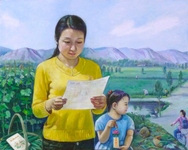
As a gentle, outer light shines downward, a different, invisible light — that of spiritual illumination — shines into the mind as a woman studies the teachings of Falun Gong. The gentle repose of the child mirrors the inner world of the follower of Falun Gong.
|
|
| Poem: A Crime [23.05.2008] |
Where human conscience becomes a crime and hearts poisoned turns eyes blind where truth revealed from freedom denied and propaganda fuelled by the 'party line'. |
|
| Different Understandings of Loss and Gain [22.05.2008] |
One day, Confucius went to the county where Kong Mie was the magistrate. It was Spring, a busy season for farming. However, there were some deserted fields with downcast farmers standing nearby. Confucius asked them, "Why are you not farming?" The farmers replied, " We were ordered not to farm as a punishment because we were not able to pay enough taxes the past six months." Confucius became unhappy when he heard this. |
|
| Confucius Asking Lao Zi about Etiquette [19.05.2008] |
For more than two thousand years, Confucius's teaching of taking the middle road and his emphasis on "kindness, justice, courtesy, wisdom and trust," and Lao Zi's philosophy of maintaining a tranquil mind and letting things take their natural course have served as the guiding principles of Chinese people. They were the moral standards for Chinese people, one governing their interaction with the outside world and the other governing the way that they handle things internally. The two played an important role in maintaining the stability of society and the harmony of the family. |
|
| Drawing: A Young Falun Gong Practitioner Runs through Tiananmen Square [18.05.2008] |
 |
|
| Poem: Fellow Practitioners [13.05.2008] |
You are magnificent Pure land is here Save, and be saved Think no other |
|
| Painting: Perseverance [11.05.2008] |
A western Falun Gong practitioner is participating in a Manhattan clarifying the truth activity. Under heavy falling snows, he unyieldingly and serenely raises a truth clarifying poster board. It reflects a cultivator's bearing of perseverance and benevolence.
|
|
| Painting: Sincere Calling [09.05.2008] |
The little girl in the painting was calling people's attention in the rain, hoping more people would learn the truth and thereby raising people's consciences to help stop the persecution soon.
|
|
| Stories from History: Qu Tutong's Well-Intentioned Advice [09.05.2008] |
Qu Tutong said to the emperor: "It is a matter of life and death. If they are executed, they will not come to life again. Your highness's kindness has spread over the whole world. Do you really mean to kill all fifteen hundred people just for these livestock?" |
|
| Painting: Silent NightTears of an Orphan [08.05.2008] |
The persecution by the Chinese Communist Party (CCP) has caused numerous Falun Gong practitioners' families to be broken up and their members dispersed. The painting shows a child holding the ashes of her parents, who were persecuted to death by the CCP, holding back her tears. Her mind is filled with suffering and she has no idea what course to follow.
|
|
| The Difference Between Giving and Taking [06.05.2008] |
|
|
| Painting: Silent Night [05.05.2008] |
The young mother in the painting, while holding her soundly sleeping child, manages to find time to study the Falun Gong teachings. The painting illustrates that she cultivates diligently while busy in her daily household work. This is a preeminent characteristic of Falun Dafa.
|
|
| A Wise Ruler Fears Three Things [03.05.2008] |
A wise ruler fears three things: Firstly, he is afraid of not knowing his mistakes because of his lofty position. Second, he fears arrogance and self-complacency when he succeeds. Third, he is afraid of not following wise advice. The ancient Chinese people advocated being modest, cautious, and vigilant |
|
| Cultivating Speech and Not Talking About Others' Shortcomings [01.05.2008] |
Divinely-inspired culture advocates that one has to be prudent about what one says. In the cultivating community, there is emphasis on the cultivation of speech, because a comment is capable of hurting others more than a sharp knife or gun could. Moreover, as soon as words are spoken, they can't be taken back, and they can create resentment and karma, thus bringing disaster to the speaker. |
|
|
| April 2008 |
|
|
| Painting: Force Feeding [23.04.2008] |
They pour in substances such as a mixture of water and cornmeal, concentrated salt solutions, hot chili paste and even human excretory waste. The intention is to inflict pain so as to break the will. Such torture is extremely painful and is the most common cause of death.
|
|
| Painting: Uncompromising Courage [09.04.2008] |
This painting was based on a true story of Mr. Liu Chengjun. Mr. Liu Chengjun was a Falun Gong practitioner from northern China. In March 2002, he was sentenced to 19 years in prison for his involvement in broadcasting programs that exposed the brutality of the persecution against Falun Gong on Chinese television. After 21 months in prison, he was tortured to death.
|
|
| Painting: Golden Lotus [08.04.2008] |
The inspiration for this painting came from a true story that has raised an international outcry. A young mother named Lixuan Wang and her 7-month-old son were both tortured to death after they were arrested for practising Falun Gong. Autopsy reports revealed that the baby had been hung upside down and his skull had been crushed.
|
|
| The Beauty of the Guqin: Upright and Profound [03.04.2008] |
The guqin is a plucked seven-string musical instrument. It has a long history and profound cultural meaning. Ancient literati and officialdom used it to express their willingness for self-improvement, family harmony, benefiting the people, and seeking peace for society. Thus, the guqin became symbolic for intellectuals. Confucius once said, "Develop sentiment with Shijing [an ancient collection of poems], act according to ethical standards, and reach maturity in harmony with music." |
|
| Stories from Ancient China: Sima Guang's View on Talent and Virtue [03.04.2008] |
Sima Guang classified individuals into four groups based on their virtue and talents: the sagacious - those who have both virtues and talents; the foolish - those who have neither virtue nor talents; the noble - those who have virtue but no talents; and the inferior - those who have talents but no virtues. When it was time to appoint an official, the first choice would be a sagacious person, then a noble person. If neither a sagacious person nor a noble person could be found, it would be better to use a foolish person rather than an inferior one. It was because individuals with talents but without virtue were most dangerous. They were worse than those who have neither talents nor virtue. |
|
| Stories from Ancient China: One Should Keep a Distance from Those Who Curry Favour [31.03.2008] |
Confucius said, "One should keep a distance from those who like to curry favour." Those who are used to ingratiating themselves are good at figuring out what their superiors have in mind and how to make them happy. With their superiors being happy, they can make up things and distort the truth, and succeed in harming those who are righteous and honest. |
|
|
| March 2008 |
|
|
| Stories from Ancient China: Talented Officials More Valuable than Auspicious Omens [28.03.2008] |
Taizhong said, "I often laughed at the Sui Emperor, who did not pay attention to talented officials but liked auspicious omens. As a result, his country perished. In my opinion, what is truly auspicious is having talented officials managing our country well, and having our people be happy and content. As for the rare birds and wonderful beasts, they are only slightly different from ordinary things. How can we celebrate this?" He then ordered the nest to be destroyed and the birds to be returned to the wild.
|
|
| Poem: Dreaming of a Divine Heart [25.03.2008] |
Loneliness, so long, my companion you've been And alone, with you, my tales are shared Into the realm of nothing we've been And together upon the gates, we've staredWe've sat alone, on mountain tops And thought of life we'd never know Up endless steps we tiredly walk With dreams to end this winter's snow |
|
| An Untitled Sketch [12.03.2008] |
These pieces were sketched in secret by a Falun Gong practitioner who was ilegally detained in prison for his/her insistence in her cultivation. Created without any proper drawing materials, only 36 of the more than 70 pieces made it outside of China. Some were lost or damaged while being passed down from one person to another, and after much difficulty they finally arrived in the United States.
|
|
| Painting: Fulfilling Vows [02.03.2008] |
The heavenly beings in this painting represent all races and cultures. There are practitioners of spiritual practice of Falun Gong in over 60 countries around the world. Its practitioners represent every ethnic group and every walk of life. Although Falun Gong originated in China, the search for truth and enlightenment is universal.
|
|
|
| February 2008 |
|
|
| Stories from Ancient China: Human Hearts Are as Clear as a Mirror [28.02.2008] |
The mirror had a special function. When one looked at the mirror from the front, it reflected the image upside down. If the person rubbed his hand over the chest, then the internal organs of the person could also be clearly seen. More interestingly, it could also distinguish the loyal from the disloyal ministers in the imperial court, as well as foretell the rise and fall of a state... indeed it was a state treasure. |
|
| Painting: In Harmony [27.02.2008] |

|
|
| Ancient Cultivation Stories: Princess Zhangzhao [20.02.2008] |
Though the emperor took good care of her, she was very diligent in her practise and was not arrogant being a royal relative. Besides meditating, she often went to the mountain to collect herbs and treated patients. From the time she became a nun in the Mount Mian area, when there was a drought she burned incense and prayed for rain. It has been said that her prayers were always answered, bringing great delight to the surrounding residents. The princess was given a nickname "Living Guanyin (Bodhisattva)." |
|
| Stories from Ancient China: Assist the Poor and Serve Those in Need [17.02.2008] |
Diwu Lun was an official from the early Eastern Han Dynasty of ancient China. He lived in what is Shaanxi Province today. He was honest, unpretentious, and generous. No matter where he worked, he was always considerate of the people. |
|
| Painting: Mountain in Layers [08.02.2008] |
 The artist, Ms. Zhang Cuiying is an internationally acclaimed Chinese artist living in Australia. From an early age, Ms. Zhang was nurtured and taught by well-known Chinese masters, in the respected discipline of traditional Chinese brush painting. Her works have been extensively published throughout China. One of many honours includes the Asia-Pacific Gold Medal for Chinese Calligraphy and Painting. |
|
| Sculpture: Buddha [07.02.2008] |

|
|
|
|
| |