



Greetings, Master!
Greetings, fellow practitioners!
I began writing this sharing in 2025 but never managed to finish it. After looking inward, I realised the delay wasn’t simply due to being busy, it revealed gaps in my cultivation, especially my weak discipline and lack of urgency.
Through continued reflection and letting go of attachments, many hidden issues surfaced, with fear being the most deeply rooted. I also saw that my compassion wasn’t as strong as I had believed. These uncomfortable realisations became valuable opportunities to strengthen my cultivation.
I have feared dogs for more than half a century. The fear began in childhood when an Alsatian approached me on my way home from school, and I fainted from terror. That memory stayed with me ever since.
It also shaped how I treated my children. When my daughters were young, I told them not to be afraid of dogs when one came near us, despite feeling anxious myself. Only later did I realise I had been hiding behind them for protection. Looking back, I feel ashamed. As a mother, I should have stepped forward, yet fear made me retreat.
These emotions existed long before I began cultivating, and back then I had no idea how to confront them. Life simply moved on, and the guilt slowly faded into the background.
Lessons Learned Through Trials and Tribulations
After becoming a cultivator, I often joined postering and leafleting activities throughout the Shen Yun seasons. Over the years, I had several unpleasant encounters with dogs, which left me with sickness karma, or perhaps it was simply fear and paranoia. Sometimes, just catching sight of a “Beware of the Dog” sign on a gate made my heart jolt, as if I had only seconds to flee before something terrible would happen. When I walked with my husband and a dog wandered near, the fear rose so quickly that I would cross the road without thinking, leaving him behind with a look of quiet despair. Each time, I wondered why this fear held such power over me, and what it might be trying to teach me about myself.
There were times when I had to ask my husband to stop the car because I felt physically sick after being chased or barked at by a dog before I even managed to place a leaflet in the letterbox. I kept telling myself that I needed to break through this predicament. How could I save sentient beings if I avoided houses where dogs might be present? I even found myself feeling jealous and irritated with my husband, who delivered leaflets to homes with dogs effortlessly. He always returned unharmed, while I felt diminished by my own fear.
By the end of 2024, I overcame my fear of dogs, a turning point shaped by trials and tribulations that revealed where my compassion and righteous thoughts had not yet stood fully upright.
One day, during a break from being on the Hotline duty, I went out leafleting in the local area. Everything felt calm as I approached a house and began sliding a leaflet through the letterbox. Suddenly, I heard the sharp rattle of a chain, and my mind instantly jumped to danger: I thought a dog was about to charge at me. I stepped back just as the front door opened. It was the homeowner, who had seen me from the window and hurried over, unfastening the chain to collect the leaflet. I screamed in shock, and he asked what had happened. I explained that I thought a dog was coming for me. Amused, he reassured me that he didn’t have a dog.
After I explained about the Shen Yun leaflet, he thanked me and added that although he didn’t have a dog, his neighbour did. His comment left me embarrassed and self-conscious, making me realise how deeply my fear had shaped my reactions.
Later, in another neighbourhood, I approached a house where a ladder leaned against the front porch, partly blocking the letterbox. No one was around, and my negative thoughts told me to skip the house. After all, walking under a ladder is considered bad luck among ordinary people. But my conscience wouldn’t let me miss an opportunity to save sentient beings. I rejected the negative thought, walked under the ladder, and posted the leaflet.
Suddenly, a large black dog appeared at the porch window, barking excitedly before jumping down and heading towards the letterbox. Startled, I pulled my hand back, afraid my fingers might be scratched or bitten. As I stepped away, I nearly knocked over the ladder. Feeling nervous, frustrated, lacking compassion and righteous thoughts, I looked outward and complained: “Fine, you scared me, I won’t save your owner!” Then I turned and walked away. I didn’t stop to consider that I had opened a loophole, and that negative consequences were about to fall upon me because of my poor character.
Master said:
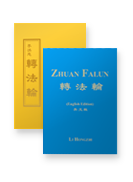
“We have said, however, that as a practitioner one should not fight back when being punched or insulted, but should hold oneself to a high standard.” (Lecture Four, Zhuan Falun)
I crossed over to the house opposite. As I tried to push a leaflet through the letterbox, the barking from the previous house still rang in my ears. Panic surged again, and I became convinced another dog might come charging at me. I rushed out through the gate and didn’t see the uneven path. I fell forward, hitting the pavement face first. For a moment I lay still, then tapped my fingers and wondered, “Am I still alive?”
When I lifted my head, I saw blood. My nose and mouth were bleeding. My face, palms and legs were injured. My husband, who had been delivering leaflets nearby, saw the accident and helped me back to the car. My trousers were torn, and the tissues I used were quickly soaked with blood. I refrained from looking in the mirror. No tears came, only a heavy sense of self-pity. Why did this happen? I knew I needed to look within.
A deep, suffocating shame rose within me when I finally saw how little I had truly done, all because I still clung to fear. I had posted leaflets here and there, convincing myself that I had fulfilled my duty. But in reality, countless sentient beings were still waiting to be saved. That truth struck me like a cold wind. It compelled me to face a painful question: Was I genuinely cultivating, or merely acting out the appearance of it?
Master said in Dafa Disciples Must Study the Fa:
“For a Dafa disciple, cultivation is first priority. That’s because if you fail to cultivate well, you will not be able to accomplish what you are to do; and if you fail to cultivate well, your power to save sentient beings will not be that great. And if you cultivate a little worse, then you will view and consider problems in the manner that ordinary people do, which would be still more awful. So you absolutely mustn’t slack off or lower your guard.”
Self-Reflection
The accident changed everything. Every movement made my knees throb. Exercises that once felt natural and comforting became trials of endurance. I couldn’t bend properly, couldn’t stand straight without pain cutting through my legs. Sitting in the full lotus position was impossible. After the fifth exercise, I had to roll onto my side and push myself up like someone who had lost all strength. Even walking down stairs felt punishing. My body felt fragile, but my heart felt even more exposed.
As I looked inward, I began to see the injury as more than physical: it reflected the state of my heart, where a quiet lack of compassion and endurance had been growing in me.
During the Shen Yun tour, the four of us walked together to the venue for backstage duties. That year, my team coordinator stopped walking beside me. Later, I learned it was simply because she couldn’t keep up with my pace. That truth struck me. My fast walking wasn’t just a habit, it revealed impatience, pride, and a need to prove myself. I realised how little I had been considering others. These moments were not coincidences, they were mirrors showing me who I had become.
I once guided a practitioner to a laundrette because she didn’t know the way. My body resisted the task, but I went anyway. We had four heavy bags on a trolley, and the route went up a steep, narrow hill. With my leg and hand still weak, I asked her to wait while I checked ahead. I made my way up slowly and felt relieved when I saw the laundrette just across the road. When I turned back, she was almost behind me, pulling the trolley alone. The sight stopped me. Her quiet determination, her willingness to carry the weight without complaint, revealed a steady strength. I felt humbled and rushed to help. We laughed afterwards, but inside I felt ashamed. I remembered telling my coordinator I couldn’t lift heavy items because of my injury. The contrast between her silent perseverance and my excuses stayed with me.
My heart remained with my parents, now in their mid-nineties, and the pull to return home grew stronger. My brothers’ accusations of being unfilial left a sting, and the misunderstanding pressed heavily on my chest. When I spoke with my father, his calm understanding softened my turmoil. He simply encouraged me to follow what felt right. Even so, the attachment of sentimentality in my heart seemed to outweigh the sense of duty.
After the Shen Yun tour ended, I felt overwhelmed and needed a moment to breathe. Yet as a cultivator, time is precious, and truth clarification work soon resumed. I also had to prepare for my Tian Guo Marching Band test, and then came an invitation to an Indian cultural event to promote Falun Gong. Instead of feeling joyful, pressure built up until it spilled over, and I found myself losing my temper at my husband simply because he was closest to me.
On the morning of the event, I ironed our new yellow Falun Gong T-shirts printed with “Truthfulness, Compassion, Forbearance”. My husband’s shirt came out perfectly. But when I ironed mine, part of the “Truthfulness” character vanished, and half of the characters for “Compassion” and “Forbearance” also vanished. I froze. My heart sank. It felt as though the universe had reached out and touched me directly.
I stopped everything, went into my study, and sat quietly. In that stillness, I understood: it was a reminder of how far I had drifted from the very principles (Truthfulness, Compassion, Forbearance) I claimed to uphold. They are not decorations on a shirt; they are the foundation of cultivation, and I had been neglecting them.
Cultivation is not about changing others, it is about transforming oneself, removing attachments, looking inward, and elevating one’s heart. Nothing happens without a reason.
I carefully coloured in the missing characters until the words were whole again. It felt symbolic, as though I was repairing something inside myself.
Recognise and Practise the Three Basic Principles in Cultivation
Five of us travelled together in one car to the cultural event, and the host welcomed us warmly the moment we stepped through the door. She offered us the centre position for our banner and even extended our exercise demonstration from the originally scheduled 15 minutes to half an hour, allowing a full voiceover explaining the persecution. When the music ended and I went to retrieve the USB stick, the organiser remarked that the exercises were so peaceful to watch. Later, she thanked us for coming, for bringing Truthfulness, Compassion and Forbearance, and even GanJing World, to their community.
The host hoped we could stay for their cultural show, but two practitioners needed to leave for work or to return home. Three of us stayed behind. Only when we were preparing to leave did it occur to me that none of us had brought jackets or umbrellas, and it was raining outside. We needed public transport, and the area was unfamiliar to me. Yet, miraculously, although the rain never stopped, we hardly got wet during the 15-minute walk to the bus stop and the connection to the train.
When we reached the bus stop, the driver wasn’t there. I noticed a small corner shop nearby and hurried in to buy some drinks. To my surprise, the bus driver was in the shop too, just about to leave. He told me the bus would wait until I returned. Not only did he let us board for free, he also told us exactly where to get off. When we alighted, he drove slowly alongside us, pointing out the direction of the train station entrance.
Conclusion
It felt as though every step of the journey was quietly arranged, a reminder that when we carry righteous thoughts and do righteous things, help often appears in the most ordinary forms.
Thank you, Master, for the wake-up call. In every moment of pain, misunderstanding, humility and endurance, Master was offering me a chance to return to compassion, patience and sincerity. The injury wasn’t a punishment—it was a mirror. And through that mirror, I began to recognise the path back to myself.
With that understanding restored, my heart felt lighter, calmer, and more grounded. And in the end, everything unfolded far better than expected.
Master said in “The Master-Disciple Bond”, Hong Yin II:
“When disciples have ample righteous thoughts, Master has the power to turn the tide”
Thank you, Master.
Thank you, fellow practitioners.
(Submitted to the European Fa-Conference 2026)
* * *


You are welcome to print and circulate all articles published on Clearharmony and their content, but please quote the source.
 more ...